


Word of the Day: 같은 #
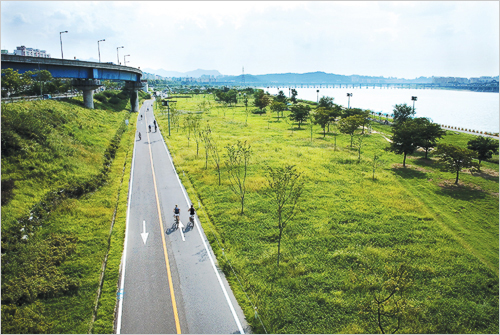
Hangang Park(한강공원)
Image credit: english.visitkorea.or.kr
같다(gatda) - alike, similar,identical Example: A person like you. 너 같은 사람(neo gat-eun saram) It seems like it's going to rain. 비가 올 것 같다 (biga ol geos gatda) We go to the same school. 우리는 같은 학교에 가요(ulineun gat-eun haggyoe gayo) I think I've forgotten. 잊어버린 것 같아요(ij-eobeolin geos gat-ayo) I suppose so. 그런 거 같아요(geuleon geo gat-ayo) Synonym: 처럼(cheoleom) - alike, similar Labels: Hangul, Word of the Day Monday, 2 June 2014 | 2 comment[s] | back to topWord of the Day: 자다 / 잠자다 #
잠자다 (jamja-da) - sleep, go to bed Example: Did you sleep well? 잘 잤어요? (jal jass-eoyo?) I can't sleep 잠이 안 와요(jam-i an wayo) I am going to bed now. 지금 자러 가야겠어요(jigeum jaleo gayagess-eoyo) Are you still awake / not sleeping? 아직 안 자니?(ajig an jani) Please brush your teeth, before you sleep. 자기 전에 양치질 하세요(jagi jeon-e yangchijil haseyo) Good night 잘 자요 (jal jayo) Labels: Hangul, Word of the Day Monday, 31 March 2014 | 0 comment[s] | back to top알바 | Part-time job #
 알바(alba) - korean slang for part-time job. Originally from the word 아르바이트(aleubaiteu), arbeit. This is a website in Korea, where people look for part-time jobs, http://www.alba.co.kr/ knowns as 알바 천국(alba-cheonguk), which means part-time job heaven. Labels: Hangul, Word of the Day, 한글 Saturday, 23 November 2013 | 0 comment[s] | back to top가을 | Autumn #
 가을(ga-eul)
Autumn / Fall 가을 날씨가 너무 좋아요 (ga-eul nalssiga neomu joh-ayo) Love the weather in autumn Labels: Hangul, Word of the Day, 한글 Saturday, 16 November 2013 | 0 comment[s] | back to tophow to say TGIF in Korean? #
 How to say TGIF (Thank God it's Friday) in Korean? 불금 (bulgeum) - This word is the short form of 불타는 금요일(bultaneun geum-yoil) which literally means 'Flaming Friday' - You can wish people 불금 보내세요 (bulgeum bonaeseyo), means Have a awesome/fun Friday. Labels: Hangul, Word of the Day Friday, 21 June 2013 | 0 comment[s] | back to topWear / Put something on #
옷을 입고 (os-eul ibgo) wear clothes 신발을 신다 (sinbal-eul sinda) wear shoes 양말을 신다 (yangmal-eul sinda) wear socks 안경 쓰고(angyeong sseugo) wear glasses 모자를 쓰고 있다(mojaleul sseugo issda) wear a hat / cap 머플러를 두르다(meopeulleoleul duleuda) Wear a scarf / muffler 머리띠를 매다 (meolittileul maeda) wear a headband 귀걸이를 하고 있다(gwigeol-ileul hago issda) wear earrings 향수를 뿌리다(hyangsuleul ppulida) Spray / Put on perfume 반지를 끼다(banjileul kkida) wear ring Labels: South Korea, Word of the Day Tuesday, 11 June 2013 | 0 comment[s] | back to top봐 #
 Sometimes you hear these sentence in drama, that ends with a '봐' '봐' means see, watch when it stands alone. Example: 영화 봐요 = watch a movie / going to the movies (yeonghwa bwayo) When it's combine with words like, 먹어 봐 or 말해 봐 Then '봐' in the end of the sentence, means 'try to do something' 말해 봐 = try say it (malhae bwa) 먹어 봐요 = try eat it (meog-eo bwa) 해봐 = try to do it (hae bwa) 거지말 해봐 = try to lie and see (what happens) (geojimal haebwa) It can also mean 'haven't try something' 안 가봤어요 = I haven't been there (an gabwass-eoyo) 안 먹어 봤어요 = I haven't eat it before (an meog-eobwass-eoyo) Labels: Hangul, South Korea, Word of the Day Friday, 24 May 2013 | 0 comment[s] | back to topSick #

Image credit: lang-8
Caught a cold 감기걸렸어요(gamgigeollyeoss-eoyo) My head hurts. 머리 아파요(meoli apayo) Sore throat 목이 정말 아파(mog-i jeongmal apa) I don't like to eat medicines 약을 먹기 싫어요(yag-eul meoggi silh-eoyo) Go to the hospital 병원에 가요(byeong-won-e gayo) Hope you'll get well soon 빨리 나아지면 좋겠네요(ppalli naajimyeon johgessneyo) Don't get hurt/sick 아프지 마세요(apeuji maseyo) Becareful not to catch a cold. 감기 조심해요 (gamgi josimhaeyo) Labels: Hangul, Seoul, taxi, Word of the Day Tuesday, 8 January 2013 | 0 comment[s] | back to topHappy New Year | 새해 복 많이 받으세요! #

Image credit: backpackingasia
Happy New Year 새해 복 많이 받으세요!(saehae bog manh-i bad-euseyo) Happy New Year (Konglish style) 해피 뉴 이어(haepi nyu ieo) Be healthy in year 2013 2013년에도 건강하세요(2013nyeon-edo geonganghaseyo) May the year of 2013 full of happiness. 행복한 2013년 되세요 (haengboghan 2013nyeon doeseyo) Hope your new year if full with only good things. 새해에는 좋은 일만 가득하시길 바랍니다 (saehaeeneun joh-eun ilman gadeughasigil balabnida) I hope everything you do will go well. 하시는 일마다 다 잘 되시길 바랍니다 (hasineun ilmada da jal doesigil balabnida) Dear readers, may you have a blessed and wonderful new year ahead. 새해 복 많이 받으세요! 그리고 2013년에도 많이 사랑 주세요 Labels: Hangul, Happy New Year, Word of the Day Monday, 31 December 2012 | 0 comment[s] | back to topChristmas | 크리스마스 #
More Christmas(크리스마스) related words! :) Christmas Eve 크리스마스 이브 (keuliseumaseu ibeu) Christmas party 크리스마스 파티 (keuliseumaseu pati) Have a Merry Christmas! 즐거운 크리스마스 되세요 (jeulgeoun keuliseumaseu doeseyo) Christmas cards 크리스마스카드 (keuliseumaseu-kadeu) Christmas socks 크리스마스 양말 (keuliseumaseu yangmal) Christmas carol 크리스마스 캐럴 (keuliseumaseu kaeleol) White Christmas 화이트 크리스마스 (hwaiteu keuliseumaseu) What did you get for Christmas(present) ? 크리스마스 선물로 뭐 받았어요? (keuliseumaseu seonmullo mwo bad-ass-eoyo?) I wrote a letter to Santa. 나는 산타 할아버지께 편지를 썼어요 (naneun santa hal-abeojikke pyeonjileul sseoss-eoyo ) Decorated the Christmas tree yesterday 어제 크리스마스트리를 장식했어요 (eoje keuliseumaseuteulileul jangsighaess-eoyo) Sent Christmas present to my friend. 친구한테 크리스마스 선물들을 보냈다 (chinguhante keuliseumaseu seonmuldeul-eul bonaetda) Have a Merry Christmas, 행복한 크리스마스 되세요 ♥! :) Labels: Hangul, Merry Christmas, Word of the Day Monday, 24 December 2012 | 0 comment[s] | back to topMerry Christmas! #

Christmas Tree at Seoul City Hall Park
Image credit: Dolcecorea
The word 크리스마스 is actually Konglish. Christmas 크리스마스(keuliseumaseu) Merry Christmas 메리 크리스마스(meli keuliseumaseu) Happy Christmas 해피 크리스마스(haepi keuliseumaseu) Christmas present 크리스마스 선물(keuliseumaseu seonmul) Received Christmas presents? 크리스마스 선물 받았어요?(keuliseumaseu seonmul bad-ass-eoyo?) Christmas song 크리스마스 노래(keuliseumaseu nolae) Christmas tree 크리스마스 트리(keuliseumaseu teuli) Santa Claus(santa hal-abeoji) 산타 할아버지 Would like go out on a date with me on Christmas? 크리스마스날 나랑 데이트할래?(keuliseumaseunal narang deiteuhallae?) Snow 눈 (nun) Have a Merry Christmas everyone :) Labels: Hangul, Merry Christmas, Word of the Day Friday, 21 December 2012 | 0 comment[s] | back to topWord of the Day: 들어가다 #

Busan(부산), South Korea
Image credit: girlandtheworld.org 들어가다(deul-eogada) -enter, go(in/into) Example: Go into the room. 방으로 들어가다(bang-eulo deul-eogada) I'll go home tomorrow. 내일 집에 들어갈께 (naeil jib-e deul-eogalkke) Don't go in there. 들어 가지마요 (deul-eo gajimayo) Labels: Hangul, Word of the Day Sunday, 16 December 2012 | 0 comment[s] | back to topWord of the Day: 받아 #

Image credit: Zimbio.com
받아(bad-a) - received, accept Example: I received Christmas present. 전 크리스마스 선물 받았어요(jeon keuliseumaseu seonmul bad-ass-eoyo) I'm really touched/impressed. 정말 감동 받았어요 (jeongmal gamdong bad-ass-eoyo) He's receiving treatment in the hospital. 그는 병원 치료를 받고 있어요 (geuneun byeong-won chilyoleul badgo iss-eoyo) Why are you not picking up your phone? 전화 왜 안 받아? (jeonhwa wae an bad-a) Labels: Hangul, Word of the Day Saturday, 15 December 2012 | 0 comment[s] | back to topWord of the Day: 오다 #

Cheonggyecheon stream in Seoul
Image credit: Flickriver
오다(o-da) - come, turn up, show up Example: The bus came. 버스가 온다 (beoseuga onda) It's raining. 비가 온다 (biga onda) She came from China. 그 여자는 중국에서 왔다 (geu yeojaneun jung-gug-eseo wassda) Please come in / Welcome (people say this when welcoming people to their house) 어서 오세요 (eoseo oseyo) Why did you come here? 여기 왜 왔어요? (yeogi wae wass-eoyo?) Come quickly 빨리 와 (ppalli wa) Labels: Hangul, Word of the Day Thursday, 13 December 2012 | 0 comment[s] | back to topKonglish #

Bead ice cream, 구슬아이스크림
Image credit: instiz.net
Christmas 크리스마스(keuliseumaseu) Hotel 호텔(hotel) Camera 카메라(kamera) Handphone 핸드폰(haendeupon) Coffee 커피(keopi) Meeting 미팅(mi-ting) Service 서비스(seobiseu) Internet 인터넷(inteonet) Kiss 키스(kiseu) Sexy 섹시(seg-si) Shopping 쇼핑(syoping) Taxi 택시(taegsi) Menu 메뉴(menyu) Ice cream 아이스크림(aiseukeulim) Banana 바나나(banana) Pizza 피자(pi-ja) Air-conditioner 에어컨(eeokeon) Team 팀(tim) As there's too many Konglish words, I'll post Konglish part 2 soon :D Labels: Hangul, Konglish, Word of the Day Wednesday, 12 December 2012 | 0 comment[s] | back to topWord of the Day: 밤 #

Night view of Seoul
Image credit: Ray Kyungjae Lee - irustyle82 밤(bam) - night Example: All night long 밤새(bam-sae) I can't sleep yesterday night. 어제 밤새 잠이안와요(eoje bamsae jam-i-an-wayo) Let's meet tomorrow night. 내일 밤에 만나자(naeil bam-e mannaja) It's so cold at night. 밤에 너무 추워요(bam-e neomu chuwoyo) Labels: Hangul, Word of the Day Saturday, 1 December 2012 | 0 comment[s] | back to topWord of the Day: 아침 #
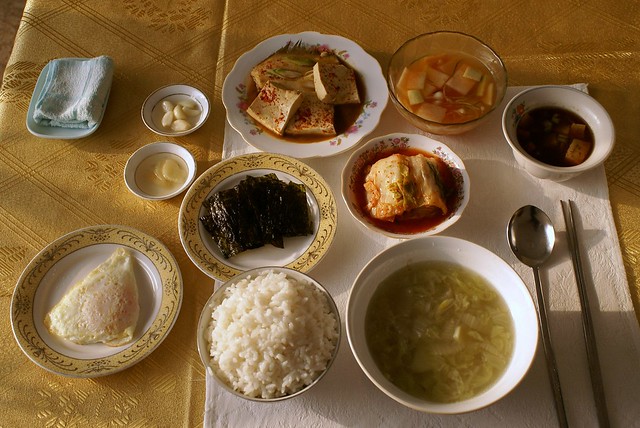
Korean style breakfast
Image credit: kernbeisser
아침(a-chim) - morning Example: I have to go tomorrow morning. 내일 아침에 가야돼요 (naeil achim-e gayadwaeyo) From morning till night 아침부터 밤까지(achimbuteo bamkkaji) Breakfast 아침밥(achim-bab) / 아침 식사(achim sigsa) *But you can't say 밤밥 for dinner. 저녁밥(jeo-nyeog-bab) stands for dinner. Good morning 좋은 아침(joh-eun achim) I wake up early in the morning. 난 아침에 일찍 일어나요(nan achim-e iljjig il-eonayo) Labels: Hangul, Word of the Day Thursday, 29 November 2012 | 0 comment[s] | back to topWord of the Day: 또 #

Jeju Island, 제주도
Image credit: http://traveladventurejl.blogspot.com
또(tto) - again, once more, repeat Example: Came again? 또 왔어요?(tto wass-eoyo) You're late again. 넌 또 늦었다(neon tto neuj-eossda) Now, are you clear about 도(do) , 더(deo) and 또(tto)? :) Labels: Hangul, Word of the Day Wednesday, 28 November 2012 | 0 comment[s] | back to topWord of the Day: 더 #

Gwang Hwa Mun, 광화문
Image credit: DSLR_MANIA
더(deo) - more, further Example: Please have some more(food) 더 드세요(deo deuseyo) Drink more 더 마셔요(deo masyeoyo) Want some more ice cream? 아이스크림 더 먹을래? (aiseukeulim deo meog-eullae?) I have more important things to do. 더 중요한 일 있어요(deo jung-yohan il iss-eoyo.) Labels: Hangul, Word of the Day Tuesday, 27 November 2012 | 0 comment[s] | back to topWord of the Day: 도 #

Han River(한강), Seoul
Image credit: http://vimac.com.vn/
도(do) - (me)too, also Example: I like rainy days too. 나도 비오는날 좋아(nado bioneunnal joh-a) I still don't understand. 지금도 이해가 안가(jigeumdo ihaega anga) Are you still angry? 아직도 화나 있어요? (ajigdo hwana iss-eoyo?) She has a car and also a house. 그녀에게는 차도 있고 집도 있다 (geunyeoegeneun chado issgo jibdo issda) 도(do) is often confused with 더(deo) and 또(tto). More on 더(deo) and 또(tto) on the coming post. Labels: Hangul, Word of the Day Monday, 26 November 2012 | 0 comment[s] | back to top |
